skip to main |
skip to sidebar
Today's outing was a day trip to Toledo. We started from the Atocha main station where we arrived in plenty of time. We were surprised to discover that the main hall, where you would normally expect to see tracks with lots of trains and people had in fact been transformed into a very large greenhouse filled with tropical plants, some enormous. At the head end there was a wide shallow pond filled with floating miniature water lilies that were being eaten by a horde fo turtles of various sizes. We happily whiled away the excess time observing these turtles sunbathing on flat rocks provided for the purpose, and more entertainingly, attempting to clamber up onto these surfaces from the water and failing, repeatedly.


The journey to Toledo was on a "medium distance" train somewhat posher and faster then the one we had previously been on. Although it was faster, the ride, i.e. track was not as smooth as I had expected. The journey took only 30 minutes and traversed a sort of plain with low level topology that leads me to think this area was once under water. At the Toledo station an interesting tourist game unfolded. One of the first things you need after arriving is a map. And what was the first thing being sold by franchisees as you exit the platform? Maps of course, at €2 each and we could see quite a few people falling into this trap. Two doors further down was a tourist office where we got an adequate map for free. We had to wait a while for a bus up the hill into the city, but it beat walking, of which there was much ahead of us.
Toledo is World Heritage listed city with lots of churches, museums , alcazar (closed) and the usual old city maze of streets. This is emphatically a tourist town with tons of tourist shops and restaurants. Many shops had large selections of knives ranging from small to swords and cutlasses, apparently harking back to its history of producing good swords. Even though they are labeled "Toledo", one wonders if they are actually made here.
Joan was keen to visit a Templar exhibition while I sat on my behind on the nearby theatre steps. The exhibition wasn't a great success as it toed the party (Catholic) line. We started to notice a sameness about all the notable buildings - churches, museums, etc. It was obvious that they had all been either rebuilt or extensively renovated. There appeared to be much new material. After a while this uniformity became boring and we found the place to be somewhat fake.

The high point for us, literally and figuratively was our visit to the Iglesia de Los Jesuitas (San Ildefonso). Unlike every other church we had seen, the interior was painted white, the shrines were freely accessible (no grates), and the wooden floor was of contemporary provenance. The white ceiling was not adorned in any way and this freshness appealed to us - we liked the place. Our reason for visiting it though was the view obtained from the towers, as this is the highest point in the city. We were amply rewarded in this regard. There was one incongruous object on our way up the towers - a Coke machine! This is a functioning church. Thirsty work climbing steps,apparently.
Finally success in the dining department! We took the LP's advice and went to their top recommendation. Unusually, the service was good, friendly and helpful, but most importantly, the food was good to, and not that expensive. Mind you, the rapidity with which the dishes arrived made you think they were trying to push you through for a quick turnover.
After lunch the temperature rose to 33° and as there was lots of up and down walking, we soon became rather tired, so we decided to cut short our stay and return on the 5:30pm rather than the 7:30pm train. On arrival back at Atocha station in Madrid we thought we'd be smart and buy tickets for our two remaining rail journeys. Good idea, but it entailed a 40 minute wait in aqueue in the un-air-conditioned ticket hall. We were rewarded by being served by a very charming and helpful (English-speaking) teller.
We had earlier intended to have dinner at the food hall we had seen next to Plaza Major the day before. However, after our exhausting day on our feet we didn't feel like more walking so we looked locally and were lucky to find an elegant Italian restaurant near the Opera. We weren't that hungry so only ordered a main dish each - two pasta dishes, which were excellent. I would go so far as to say the best we have had so far.
Although we had previously decided to go to Aranuez, when the 7:30 alarm woke us up, we decided that a lazy Sunday in Madrid was a better option - there didn't seem to be much point in traveling to another city to see a royal palace, when we have the palace just around the corner. Anyway, at this early hour we were still foot-sore from the day before.
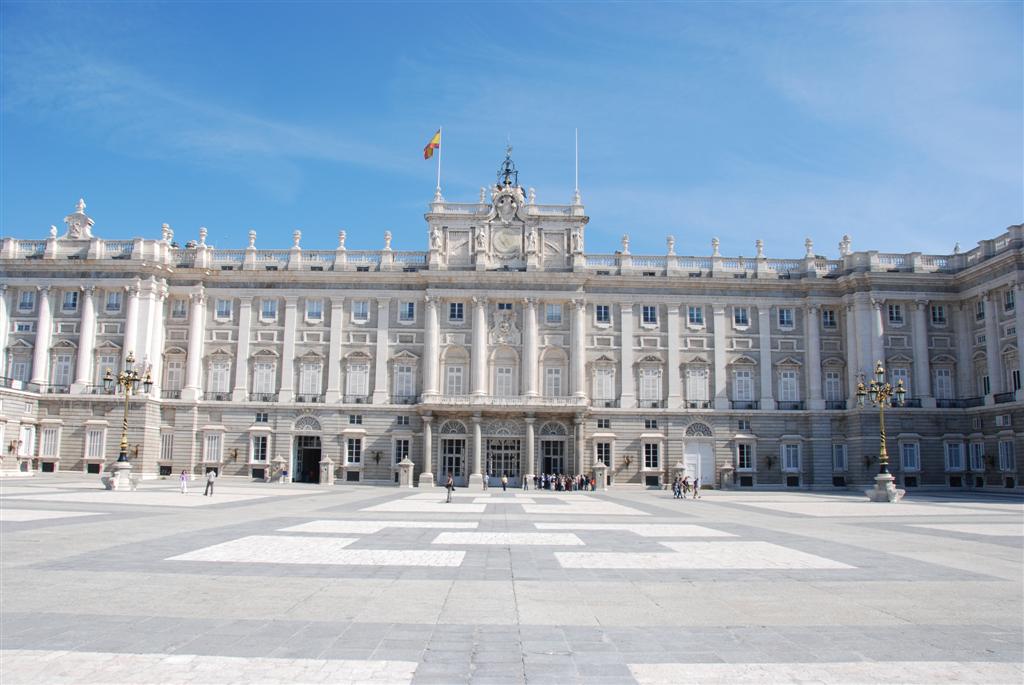
A few hours later, in brilliant sunshine we made our way through Plaza Oriente to the sound of beating drums. It soon became clear what they were in aid of - another fun run, this time along the front of the palace, blocking our way. We had to choose a gap carefully before dashing across to the palace entrance.

We first saw a temporary exhibition Crown and Archaeology, showcasing the royal family's and in particular Charles III's interest in history, archaeology and collecting. He issued several edicts promoting the preservation of antiquities and collection of history. The exhibition was at pains to make clear how the Spanish were at the forefront of the birth of archaeology, going so far as to state that this contribution by the king(s) was largely unknown both inside and outside the country. Perhaps this should be taken with a grain of salt?
We next did the normal tour of the palace, through various reception, sitting and dining rooms, and the throne room. The latter is the epitome of excess of decoration - there wasn't anywhere you could look to rest your eyes. In fact the whole palace seemed rather overdone to us. Paul Keating would have loved the extensive clock collection - dozens of them. There were quite a few paintings, with many portraits of the royals, most of them of the rather homely Charles III. On the whole, it did not make a big impression on us.
The two additional exhibitions were much more interesting. Joan went to see to Royal Pharmacy. In several rooms there were floor to ceiling shelves stacked with named porcelain jars of the pharmacopeia of the day. She recognized a few substances, including quinine, digitalis, iron, rhubarb, salvolataly, etc.
The Armoury held an impressive collection of armour for men, children and horses. Almost all of them were highly decorated and showed superb craftsmanship. Many of the helmets were made in Augsburg Germany. There were some firearms and they were beautifully crafted but looked rather heavy and unwieldy. Interestingly, all the exhibits (rampart chargers and suits of armour) were on raised platforms to make them look more imposing, and so that the people didn't look so short, I imagine.
In the above you can see the snow-covered mountains we saw yesterday.
We had lunch back at FrescCo and then decided to stroll the city to take in the Sunday ambience. Good thing we did too, as our goal, Gran Via, had been closed to traffic to celebrate 100 years of the existence of this major avenue. Pedestrians were out in full force, enjoying the experience of strolling in the middle of the street. It sort of reminded us of the 25-yearly Harbour Bridge walks (we have done two and are hoping to be around for a third).
"This building was the seat of the supreme council and tribunal of the Inquisition from 1780 until its extinction in 1820". The previous one is a view from our window.
We decided to have dinner at the Plaza Major, to enjoy the outdoor ambience. Of the eight or so restaurants we picked one of the classier ones (tablecloth) with a more expensive night menu that we hoped would improve our dining experience. Sad to say we disappointed on several fronts - the food was almost inedible, the wine wasn't good and the service was on the brusque side. The local buskers make a nuisance of them selves at each restaurant in turn. First they play from a distance of five or so metres away, and then come much closer where their playing is even more annoying, as we were in the front row. The restaurant staff are unconcerned about this affront to their customer's ears.
To top it off, on exiting the square, Joan experienced her third pickpocket attempt. This time she actually felt the hand on her bag and automatically swore at the male offender, who naturally feigned innocence. However, we were cheered up when we found a bustling food hall just outside the square with many authentic-looking tapas bars.
After a carbo-loaded breakfast at the deli/cake_shop/café directly opposite, we made our way to the main station at Atocha and purchased our discounted tickets to San Lorenzo de El Escorial. The train journey took more than 15 minutes just to exit the sub-terrean city metro system and over an hour in all to our destination. LP had advised 40 minutes - the difference being due to the fact that we were on a weekend all-stops service. On the way we could see the snow-capped Sierra de Guadarrama range.
El Escorial is an attractive small town with up-market houses and plenty of restaurants. It came into being as a result of Phillip II's decision to build a monastery/palace on a small plateau under the mountains. We made our way up to the monastery following the sign indicating "Monastery". It took us there via a winding road, which we later found was intended to be the route for cars, not pedestrians. We got there though.

The "monastery" complex is in fact large and imposing, incorporating a basilica, chapter house and library as well as courtyards. It couldn't only be for humble monks. It more aptly reflects P-II's vast ego methinks. We only got to see a small number of the rooms - those with lots of religious paintings. We didn't find them that good or that interesting. Some of the facility is still in use, but we saw no monks. No photography again, darn it.
The most interesting rooms were those displaying the original construction tools, esp. huge scissor hooks for lifting stone slabs, and models of cranes, etc. Also a large hall with one side facing a large courtyard, the other entirely covered, floor to ceiling, with frescoes depicting glorious battles of the reyes catolicos. The hall we liked the best was the library, also frescoed, mainly on the ceiling, and displaying beautiful illuminated books, as well as globes and "music of the spheres" devices.
Also interesting was the private apartment of Phillip II, notable for its relative simplicity, small bed and tiny chamber pots. He actually died in this bed. There were also some really good wooden inlaid doors and frames. There was a panel in the door depicting a scene with perspective - no mean feat in my book.
The basilica was a big space with two main features - a large golden four-panel altar piece and gloriously painted ceilings. It was bone-chillingly cold in there (we were in short sleeves). You could imagine the monks freezing their socks off.

As is our fate, part of the complex - the main crypt - was closed for renovation, but we got to see the infantas crypt. The monastery is surrounded on two sides by a formal garden featuring elaborately patterned box hedges. The garden has a great view over the plain below and one could see the outer suburbs of Madrid in the distance. On the horizon we could see four large towers that Joan said we had passed on our way up.
We mustn't forget to mention the plaza on the other two sides of the complex. On thinking about it, these are probably the largest open man-made spaces we have encountered in our travels.

After our tour we were famished - it was 3pm, so we sought out a café/restaurant, of which there were many. We chose one that appeared to offer good value for money and enjoyed what was probably the best meal we have had so far. We have come to the conclusion that we may have to pay more than we would like to get an acceptable standard of meal. This one was €16.50 (AUD 24) per person for three courses and a carafe of very nice Beaujolais-like wine. In the past we had been aiming for €10-12 but now we can see why we had no satisfaction at that price level.
After the meal we strolled around the upper town, looking for a good view of the monastery, and eventually being rewarded. We quick-marched our way back to the station along a wide tree-lined pedestrian avenue, dead straight and about a kilometre in length.


At the end of the day we are lying on our beds but hearing the sounds of many human voices drifting up from street level, we feel connected to the rhythms of life in Madrid
Due to yesterday's exhaustion, we slept in very late - 10 am, and decided on a light schedule to spare my sore little toe, which had flared up with another blister on account of the abuse it received. We decided to visit the Thyssen-Bornemisza in the afternoon and plotted an efficient metro route there.
Before that we quickly revisited Plaza Oriente in the hope of catching some photos of the palace bathed in brilliant sun. By the time we got there a few minutes later I just managed one distant shot before the clouds rolled over. We waited for a while hoping for clear patches, but gave up after ten minutes or so.
On the metro, we exited at a stop three stations from Opera, putting us on a major avenue with a great number of imposing and impressive buildings.

This unprepossessing new public building houses a private collection of the German Thyssen family. It's not as big as the two we visited yesterday, but what a collection! In the medieval/Renaissance section were an astounding number of really good paintuings, most by artists unknown to us. We were just blown away. Unlike other museums, you get could get up close and personal with most works to examine the detail - there were very few barriers, although some were under glass. Despite late arrival (we had brunch at 1pm in the museum café), there were surprisingly few people about, as many were probably in the temporary Monet exhibition.
My favourite work was a small diptych by Jan van Eyck depicting two marble statues of the virgin and the archangel. They had an uncanny realism and 3-D effect that was startling, especially considering the era. Joan's favourite was a medieval birthing scene supposedly of St Anne giving birth to the virgin, by one of these unknown artists. She was also pleased to see a small Hans Holbein portrait of Henry VIII which seemed very familiar to us.
Having learned our lesson yesterday, we skimmed through the remaining galleries of post-Renaissance and modern art as my feet and back were suffering. There were some very good pieces by Picasso, Miro, Dali, et al.
On our way back, we had another pickpocket experience as we boarded the metro. This time a group of three short women (Joan thinks a mother and daughters team) attempted to press in front of me to get in the carriage, which attempt I unchivalrously foiled - the young woman seemed surprised by this. At the same time Joan had recognized the woman as having a suspicious appearance, as she had appeared to be sussing us out while we were waiting for the train. Even though Joan was now on high alert, the woman still managed to unzip her handbag under the cover of a coat carried on her arm. Fortunately, Joan noticed this and quickly snatched the bag around to her other side. With much grumbling the team got off at the next station to look for other targets.
We went out for dinner at about 8:30pm, but it was such a beautiful evening that we joined the many locals in their Friday night passeo, heading over to the Plaza Oriente yet again. We basked in the gorgeous evening sunligh, walking through the square and the palace gardens. This is the first time that Joan has been able to enjoy a stroll arm-in-arm with Lothar without it being a route march (I had no idea :). On the cathedral side we were able to view the large palace forecourt. We may be able to get in there during daytime hours.
We did have dinner, in a Fresco buffet literally around the corner from our hostel. There is an excellent choice of salads which we were absolutely craving at this stage. The LP gives it the Good Housekeeping seal of approval.
What a day this has been, and a long one - out at 10:30, back at 20:00. We made a flying start at our objectives, visiting the Prado, and unintentionally the Museu Nacional Centrode Arte Reina Sofia. We had taken the metro from Puerta del Sol near us to Atocha with the Reina Sofia just around the corner. We bought a three-museum pass to the Prado, the Reina Sofia and the Thyssen-Bornemisza at the Reina Sofia (because of allegedly shorter queues there - more on this later).
Our real goal was the Prado, half a kilometre up the road and we walked there of course. Here we followed a familiar procedure - convert the bulk ticket into a specific ticket for this museum, and walk around the building to the entrance. Before they even check the tickets you have to put your stuff (camera, backpack, etc) through the X-ray machines that are prominent at most public buildings. Then you have to put your bag into a storage locker, for which you have to insert a coin that you later get back. At the Prado you have to have to hand your bag in at the cloakroom. At other museums (Barcelona, Sevilla they would let you put the backpack on your front, but not here).

Although we had intended to be selective, we plunged right in and saw pretty much everything, lingering only at pieces that particularly appealed to us. Fortunately, we have similar tastes. We were just overwhelmed by the sheer number of fabulous paintings. Near the beginning we were blown away by Hieronymus Bosch's Garden of Earghtly Delights, a work that we had not expected to see in the flesh. We particularly enjoyed the Flemish masters, whose realism seemed more in tune with our tastes.
There were works here by just about every Rennaissance and later artist you can think of - Rubens, Rafael, Rembrandt, Tintoretto, El Greco, Fra Angelico, Durer, Breughl, Titian, Veslasquez, Goya, Van Dyck, Caravaggio, Murillo, etc. The iconic paintings here are Velasquez's Las Meninas and Goya's the Naked Maya. It really was thrilling to see these well-known works. Unfortunately of course, there was no photography allowed, something not clearly signposted. As I was taking my first picture, I saw a hand waving agitatedly in the viewfinder - an attendant indicating that this was not allowed. Bummer.
We had a serendipitous moment though when we came across a marvelous painting relegated to a corridor adjacent to a bank of lifts. It was a very large work, seven or eight metres long, entitled The Beheading of Saint John the Baptist and Herod's Banquet by an artist unknown to us - Bartholomaus Strobel 1630. The painting had many characters with exquisitely detailed faces and garments.We lingered for quite a while.
Another surprise was the huge number of great statues from the Roman era. Many apparently are copies of Hellenic originals.
We weren't overly impressed by the highly-regarded Spanish painters, as their style, subject matter and technique didn't grab us that much. This is not to say that there weren't some great works. All these opinions of course come from the great art connoisseurs that we are!
On exiting the Prado at 16:30, when we thought we had finished for the day, we realized that we may have mistakenly obtained a same-day-only ticket to the Reina Sofia when I bought the bulk tickets there in the morning. So we hurried back there to verify the situation, and in fact a ticket for that museum had been issued and could not be changed, so in order not to waste it, we had to embark on another marathon of viewing here at the Reina Sofia.
This museum specialises in modern art and the iconic work housed here that we were interested in was Picasso's Guernica. It took a lot of searching to find it, but after almost an hour we succeeded. Photography not allowed in this room There were also surprisingly many outstanding pieces by Picasso, Miro and Dali.
We were parched and dreadfully foot-sore after this double-whammy so we parked ourselves in an outdoor Cerveceria in the square outside the museum. We liked the look of the calamari bocadillos being served to other customer so we decided that this would be our evening meal - but again no vegetables - these are sorely lacking in our Spanish diet. Before this trip we were both on a low carb diet, but this has been completely reversed due to lack of choice. We decided to work off the carbs by walking home along Calle Atocha, but didn't realize it was mostly uphill.

We are both pleasantly surprised by the ambience of Madrid, which we think rivals that of Barcelona. We had expected something completely different, a more bland and modern fast-paced city. This may indeed be the case in other parts of the city, but not in the centre, which is pedestrian-friendly and full of charming plazas.
The finest we have seen so far is just around the corner from us - the Plaza Oriente, referred to yesterday. One entire side of the plaza is taken up by the Palacio Real, a huge palace topped by statuary, now apparently occupied by security forces. The other sides are bounded a semi-circle of attractive apartment blocks and the opera house. The attractiveness is enhanced by the use of paint. The middle of the plaza is a lovely formal garden frequented by strolling Madrillenos. Initially while we were there it was overcast, but then for a brief period the sun burst through throwing brilliant afternoon (7:30 pm here!) light onto the semi-circle. At the same time, menacing dark clouds filled the sky from the east, producing a sublime contrast.
We bought a couple of bottles of Crianza red from a butcher shop. Actually, like most of these places it specialises in Iberian cured ham, of which there is a huge amount. We now have a clue as to where the Argentinians' obsession with Lomo (meat) comes from.